

Artificial intelligence in advertising is often discussed in extremes today. Either as a technology that will replace graphic designers, photographers, copywriters and perhaps entire advertising agencies within a few years, or, conversely, as a tool whose outputs are generic and which professional creative work can easily do without.
Our experience at MAISON D’IDÉE is much more pragmatic.
We use AI practically every day. In some parts of an advertising agency’s work it is fantastic, and in a relatively short time it has fundamentally changed our workflows. In other situations, however, we use it very carefully – and for some tasks we even deliberately leave it aside.
We are gradually discovering that the most interesting question is no longer whether an advertising agency uses AI, but where it uses it and where it has enough experience not to use it.
For us, the basic rule is simple: AI should expand the possibilities of a creative person, not replace their judgement.
1. We use AI for research, data collection and preparing materials
One of the areas where AI saves us an enormous amount of time is the initial collection and processing of information. With a new project, we need to understand the category, the product, the competition, the terminology, consumer behaviour and many other connections.
What used to mean hours of mechanically going through materials, we can now speed up significantly. That doesn’t mean we automatically treat AI as a source of truth. We verify important information and work with original sources for relevant data. But AI helps us dramatically with orientation, summarising and finding connections.
As a result, we spend less time searching for information and more time interpreting it.
2. We use AI for supporting copy and working copywriting
AI is excellent for texts whose job is not to define a brand’s personality but to communicate information effectively. It can significantly speed up working texts, description variants, first drafts, summaries, presentation materials or adaptations of existing content.
But here, too, a rule applies that I think captures practically all work with generative AI:
The quality of the output depends very heavily on the quality of the input.
If you don’t know what you want to say, AI won’t solve it for you. But if you have a clear idea, a line of argument, a tone of voice and good input, it can speed up the whole process considerably.
3. We use AI to prepare presentations
This is exactly the kind of work where, in my view, it makes no sense for an experienced creative person to spend hours on mechanical tasks.
Structuring extensive material, summarising documents, preparing supporting text or creating working versions of a presentation are all activities where AI can save us a lot of time.
And we’d rather invest that time in meeting the client, discussing strategy or the creative work itself.
4. AI has largely replaced traditional stock photo libraries for us
This is one of the biggest changes we’ve seen recently.
The traditional stock library had one fundamental problem: the creative person had to look for a photograph that came as close as possible to the idea they had in their head.
Today we can reverse this process.
First we have the idea, and then we create an image that matches it.
Instead of the compromise of “this photo is probably the closest”, we can get much closer to what we originally intended. For the client, this means lower costs, greater flexibility and, above all, far broader creative possibilities.
5. We use AI to create creative variations quickly
In the past, with every additional variation we had to ask ourselves whether the time needed to create it was worth it.
Today, that threshold is somewhere else entirely.
If we have a good core concept, we can test different compositions, colour schemes, settings, formats or applications much faster.
AI therefore allows us to go deeper with a good idea. Not necessarily to produce hundreds of random options, but to explore the ones we believe in far more thoroughly.
6. We use AI in packaging design for packaging variants
In packaging design, AI is extremely useful, especially in the exploratory phase.
For example, we have a basic packaging concept and need to see how it will work across different product formats. How it changes with a different material. How it will look in a different setting or across an entire product line.
We can test all of this much faster.
The designer can then focus more on the packaging system itself and spend less time mechanically producing every single visualisation.
7. We use AI for flavour variations and product lines
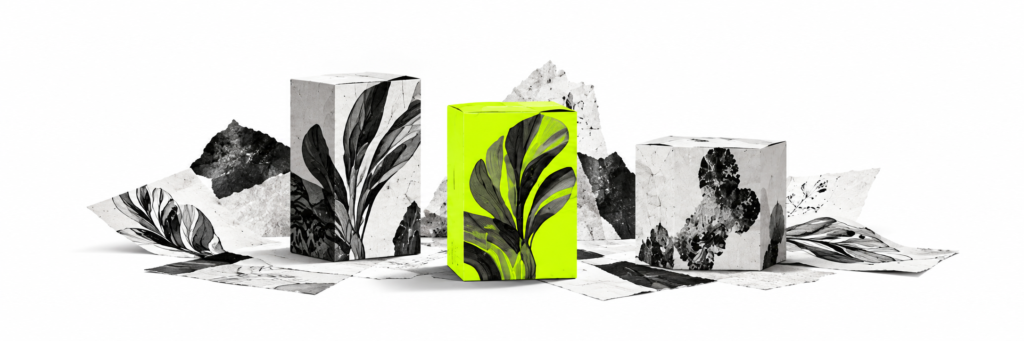
This is another example where the client can feel a very tangible financial saving.
Imagine we’re designing packaging for a product that comes in ten flavours. In the past, creating high-quality product visuals for each flavour could mean a separate photo shoot, retouching and post-production.
Today we can handle part of this work in a hybrid way.
We have a high-quality base, and with AI we can create the individual variants, change ingredients, settings or other visual elements. We then, of course, check, correct and professionally finish them.
This way, the client can get a significantly larger volume of high-quality material for the same budget.
8. We use AI for branding applications
When creating a visual identity, we need to see how the brand works in the real world.
On a vehicle. On a building. On packaging. On textiles. In store. On social media. On a large billboard and on a small phone screen.
AI allows us to create far more of these situations and test whether the proposed visual system really works.
And in my view, this is one of the best examples of how AI raises the quality of an agency’s work without replacing the creative decision itself.
9. We use AI in photography – but the photographer hasn’t disappeared
In my view, professional photography is becoming an increasingly hybrid discipline.
A photographer can shoot a real product, person or the base of a scene and then use AI to extend the setting, adjust the scene, remove technical limitations or create variants that would otherwise mean hours of additional production.
That’s why at MAISON D’IDÉE we don’t see AI as a replacement for the photographer.
We see it as another tool in their hands.
Just as digital photography didn’t replace the photographer but changed the way they work, AI today multiplies the possibilities of a good photographer. And a skilled photographer is often exactly the person who can judge why an AI output doesn’t look natural and how to fix it.
That’s why I believe the photo studio of the future will be neither purely physical nor purely virtual. It will be hybrid.
10. We use AI in illustration and post-production
Illustration is changing in a very similar way.
Today, an illustrator doesn’t have to see AI as competition. They can use it for exploration, working sketches, composition variants or creating individual elements.
What remains decisive, however, is their own visual language and the ability to control the result.
Here, too, a hybrid approach works well for us: a human sets the direction, AI expands the possibilities and a human finishes the result.
⸻
Where we don’t use AI in an advertising agency – or use it very carefully
Perhaps even more important than the list of what we do with AI is the question of what we don’t want to entrust to it.
Because the ability to use a new tool isn’t just about knowing what it can do. It’s also about knowing its limits.
1. AI shouldn’t create a brand’s core strategy on its own
AI can help us with the inputs. It can analyse materials, summarise information, help with competitor analysis or generate hypotheses.
But we don’t entrust it with the decision about where the brand should go.
Strategy isn’t a collection of information. Strategy is a decision.
And for fundamental decisions, we want an experienced person who can stand behind them.
2. We don’t use AI as the starting point for a core creative concept
This is one of the things I consider extremely important.
If you open AI first for every creative brief and ask it for twenty ideas, you can very easily narrow the space in which you’ll then be thinking.
We try to work the other way round.
First, we think.
Paper, pencil, discussion, sketch, idea.
Only once we have a direction do we use AI to develop it.
3. AI shouldn’t decide a brand’s positioning
Positioning is a strategic choice that can shape a company for many years.
AI can prepare twenty options. It can analyse the competition and help name the individual positions.
But it shouldn’t be the one deciding which of them the company should occupy.
For that, we need to know not only the data but also the reality of the company, its people, product, history and ambitions.
4. AI shouldn’t design a logo on its own
Of course, it can create a logo.
It can create a thousand of them.
And that’s exactly the problem.
A logo isn’t a standalone image. It’s part of a system that has to work for many years and in a huge number of situations.
AI can be fantastic for exploration. But in our view, the final decision and execution belong to the designer.
5. We don’t use AI to blindly follow branding trends
If you ask AI for “modern branding 2026”, you’ll probably get a very convincing synthesis of what’s modern in 2026.
And that’s exactly why the result may look dated in a few years.
When creating a brand, we’re not only interested in what looks good today.
We’re interested in what will look good in five or ten years.
And the ability to distinguish between a short-term trend and a long-term shift comes above all from experience.
6. AI shouldn’t make packaging design decisions on its own
In packaging, there’s a lot of reality that a beautiful AI mockup won’t show.
Material. Print. Production. Colour. Legibility. Mandatory information. Costs. How the package behaves on the shelf. The real competition next to it.
AI can create a gorgeous box that may not work at all in reality.
That’s why we use AI for exploration and visualisation. Not as a replacement for a professional packaging designer.
7. We don’t use AI unchecked for factual and expert claims
A generative model can phrase even incorrect information very convincingly.
That’s why, with data, figures, legal claims, expert information or anything that could have a significant impact on the client, it isn’t enough for the answer to “sound right”.
It has to be verifiable.
AI can help us find and process information. But responsibility for its accuracy must remain with a human.
8. We don’t use AI to create a final output without human post-production
For us, an AI output is generally not the goal.
It’s material.
A graphic designer refines it. A photographer corrects it. A retoucher fixes it. A copywriter rewrites it. A Creative Director judges whether it fits the overall concept.
It’s precisely this last step that is critical.
AI very often creates something that is impressive at first glance, but on closer inspection you find that something simply doesn’t fit.
9. AI shouldn’t replace contact with the client
I consider this one of the most important boundaries.
I don’t want AI to let us spend less time with the client.
I want it to let us spend more time with them.
If technology saves us five hours when preparing a presentation, the ideal outcome, in my view, isn’t just an invoice that’s five hours lower.
We can pass part of the savings on to the client and invest part in further quality: a longer workshop, a personal meeting, a store visit, a deeper understanding of the customer or another round of creative thinking.
10. AI shouldn’t make the final creative decision
In the end, all of this comes down to a single point.
AI can create a hundred options.
But someone has to say: this one is right.
And they have to be able to explain why.
Not because they simply like it. But because they know the client, their brand, history, customers, competition and business goal. Because they’ve been through many projects that worked – and many that didn’t.
This is where, in my view, the value of long-term experience remains irreplaceable.
In our view, the future of the advertising agency isn’t AI. It’s hybrid.

When I look at the way we work at MAISON D’IDÉE today, I don’t see a future in which AI replaces creative people. But I also don’t see a future in which a good advertising agency works the same way it did ten years ago.
I see a hybrid.
A photographer who shoots and at the same time works with generative tools. An illustrator whom AI allows to expand their own visual language. A graphic designer who can test many times more applications of their concept in the same amount of time. A strategist who, instead of days spent sorting through materials, can devote more time to interpreting them. A Creative Director who doesn’t have to spend hours preparing a presentation and can instead sit with the client and work out where their brand should go next.
AI doesn’t replace a good professional. It multiplies their possibilities.
And that’s exactly how we try to use it.
Not as a machine for average ideas. Not as a substitute for experience. And certainly not as a reason to remove people from the creative process.
We use it where it allows us to be faster, more flexible and more efficient. Where it can save the client money. Where it lets us explore more options and develop a good idea much more deeply.
And we deliberately limit it where judgement, experience, personal contact and the ability to make the right decision are needed.
Because perhaps the biggest change AI brings to advertising agencies won’t be that we need fewer people.
Perhaps it will be the fact that good people will finally have more time to do what they’re truly good at.


