

Artificial intelligence fascinates me every day. The more we use it, the more convinced I am that it is one of the most powerful work tools we’ve been handed in decades. At the same time, the more I work with AI, the more respect I have for its other side: it can be incredibly useful, and it can also be incredibly convincing when it’s wrong.
And it’s the second part of that sentence that I think matters. The problem isn’t just that AI makes mistakes. People make mistakes too. The problem is that AI can deliver a wrong answer in an extremely convincing, logical and professional way. It can give you a perfect line of argument, create a beautifully structured analysis and lead you step by step to a conclusion that is simply wrong.
If you work in a field you understand well, you’ve probably experienced this strange moment already. AI gives you fantastic information, finds connections that might not have occurred to you, helps you think – and then suddenly makes a mistake that you, as an expert, recognise immediately. Sometimes it’s minor. Other times it’s fundamental.
And every time, I ask myself one question: What if I didn’t understand this field?
The most dangerous AI mistake is the one you can’t recognise
If you use AI in a field where you have twenty years of experience, its mistake might amuse you. But if you use it in a field you know practically nothing about, the very same mistake can convince you.
In my view, this is one of the biggest paradoxes of today’s artificial intelligence.
AI is fantastic precisely because it allows us to enter fields we don’t understand. We can quickly find our way around a new industry, grasp the basic terminology, get an overview of a market or have a complicated problem explained to us. At MAISON D’IDÉE, we use it this way regularly.
But we need to be aware of the difference between AI helping us understand a problem and letting it make a fundamental decision for us.
The greater the consequences of a decision, the bigger the problem a single wrong assumption can cause.
I’m surprised by who uses AI the most today
While working with AI, I’ve noticed another interesting phenomenon. It’s just my personal observation, of course, not research, but it still interests me a great deal.
I would have expected the most intensive AI users to automatically be the youngest people. Yet in my own circles, I often observe something quite different. I’m fascinated by how intensively people aged roughly 40 to 60 are able to use AI.
And I started thinking about why that might be.
Perhaps one of the reasons is simply that they have more seeds to plant.
Someone with twenty or thirty years of professional experience carries a huge number of topics, problems, dead ends, ideas and questions in their head. They know what to ask. They know where a problem might lie. And above all, they often already know how much they don’t know.
AI then allows them to develop these “seeds” incredibly quickly.
They can test a hypothesis, compare options, have a connection explained, follow up with another question and, within an hour, get to where it once took them several days.
Not because AI has replaced their experience.
Quite the opposite. Their experience allows them to use AI better.
The tool still doesn’t make the master
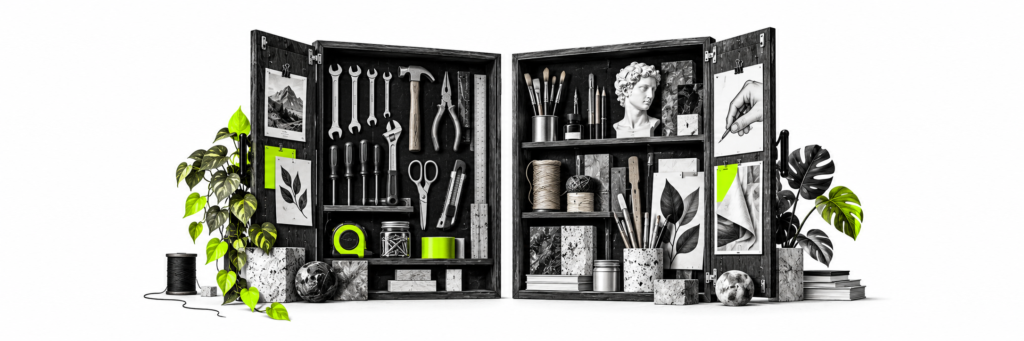
So perhaps, after an enormous technological leap, we’ve come back to a very old truth: it’s not the tool that makes the master.
You can give two people exactly the same professional camera, and one will create an exceptional photograph while the other produces an average picture. You can give them the same graphics software, the same camera, the same workshop or the same musical instrument.
Technology can remove the technical barrier. But it doesn’t automatically provide experience, taste and judgement.
And AI may be the most extreme example of this principle we’ve seen so far.
Two people have access to the same model. One gets a generic answer from it. The other conducts a series of very precise questions, challenges the answers, adds their own experience, changes assumptions, pulls the AI back when it goes in the wrong direction, and uses it as a partner to develop their own ideas.
The tool is the same.
The result can be completely different.
What will happen to juniors in the age of AI?
And here, I think, we arrive at a much more serious question, one that will matter to the entire creative industry.

How will we raise the next generation of seniors when AI does a large part of junior work?
A senior graphic designer, Creative Director, strategist or experienced packaging designer wasn’t born senior. For years, they did a great deal of work that perhaps wasn’t always fascinating. They prepared variations. Retouched. Put together presentations. Sat in on production. Made mistakes. Saw their design fail. Listened to the client. Experienced a print shop where the result differed from the screen. Saw packaging that looked fantastic on a large monitor and completely disappeared among competitors on the shelf.
And it’s from thousands of such small experiences that judgement gradually develops.
If we now skip a large part of these steps with the help of AI, we have to think about how people will gain the necessary experience in other ways.
For advertising agencies, I believe this will be one of the most important questions of the coming years.
AI in branding: a beautiful solution can be strategically wrong
In branding, the risk of a wrong decision is extremely high, because its consequences can last for years.
AI can prepare names, positioning, claims, colour palettes, logos, moodboards and entire visual identities. And it can present them so well that you can very easily get the feeling that you have a finished solution in front of you.
But a visually convincing solution isn’t necessarily the right strategic solution.
It may be too similar to the competition. It may be based on a trend that is just reaching its peak. It may work fantastically on one AI mockup but fail in hundreds of real applications. Or it may simply steer the brand somewhere completely different from where it needs to go.
And AI can produce a very convincing justification for each of these decisions.
That’s why the experience of someone who has seen many brands emerge, operate, change and sometimes fail remains critical.
AI in packaging design: there’s a big gap between visualisation and reality
We see this even more clearly in packaging.
Today, AI can create beautiful packaging in a few seconds. It can place it on a perfect mockup, light it and show it on a perfect-looking shelf.
But packaging exists in the physical world.
It has to be manufactured. It has to be printed. It has a specific material. Colours behave in a certain way. There are technological constraints, mandatory information, legibility, hierarchy, logistics, production costs and dozens of other parameters.
And above all – packaging won’t exist on its own on a beautiful mockup.
It will stand next to twenty competitors.
An experienced packaging designer therefore doesn’t just judge whether a design looks good. They think about whether it will work in reality. And sometimes, thanks to previous experience, they can identify a problem before it becomes an expensive mistake.
AI is a very convincing partner. Not an infallible authority
This is perhaps the simplest rule we try to follow when working with AI at MAISON D’IDÉE.
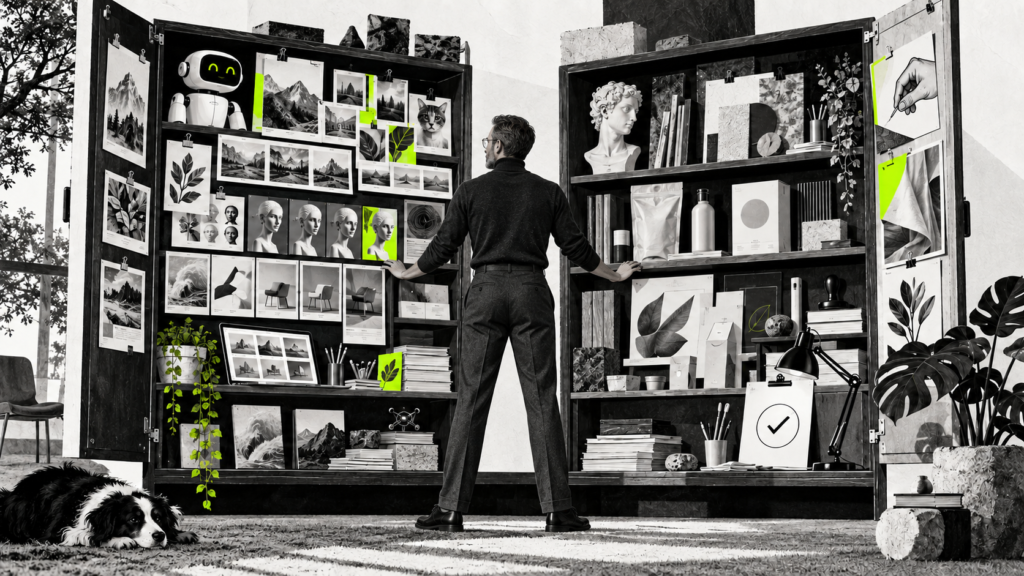
The more important the decision, the less we rely on a single AI output.
We use AI for research, analysis, exploration, variations, visualisations, copy, alternatives and many other tasks. We let it challenge our own proposals. We ask it for arguments against our decisions. We use it to broaden our perspective.
But when it comes to a fundamental decision, at the end there has to be a person who understands the field and is able to say: this makes sense, and this doesn’t.
Not because humans are infallible.
They’re not.
But an experienced person can put information into context, notice an inconsistency, question an assumption and, above all, knows that some things need to be verified.
The biggest risk of AI may not be a wrong answer, but too much trust
AI gives us a strange sense of certainty. It answers instantly. It phrases things calmly. It can argue. It doesn’t hesitate. And the result often looks far more professional than its actual reliability warrants.
That’s why I believe that, paradoxically, as AI quality grows, we need to cultivate a greater degree of doubt.
The better its answers look, the harder it will be to recognise the moment when it’s wrong.
And that is exactly why the value of real expertise may rise rather than fall in the future.
An expert won’t necessarily be someone who can produce information faster than AI. Often they can’t do that even today.
It will be someone who can judge whether information is correct, relevant and usable for a specific decision.
AI multiplies abilities. And it can multiply mistakes too.
At MAISON D’IDÉE we use artificial intelligence intensively, and I’m convinced we’ll use it more and more. It allows us to do more work, go deeper in our designs, create more alternatives and spend less time on mechanical tasks.
But the more we use it, the more we realise one simple thing.
AI is a multiplier.
In the hands of an experienced person, it can dramatically multiply their abilities. It lets them work faster, think in broader contexts and explore options they previously wouldn’t have had time for.
But in the same way, it can multiply a flawed assumption.
And if the foundation is already wrong, AI can develop it into an extremely sophisticated, beautifully presented and very convincing wrong solution.
That’s why I would be most cautious precisely where decisions matter most: in strategy, positioning, branding, packaging and other decisions whose consequences a company will carry for years.
Let’s use AI. Let’s experiment with it. Let’s let it save us time and money. Let’s let it expand our possibilities.
But let’s not mistake a convincing answer for the right answer.
Because the more perfect the tool we’re given, the more it will matter who holds it – and whether they can recognise the moment when the tool is wrong.


